At a recent conference held in Toronto, directors of pedagogical services and special education from Ontario’s French-language school boards, along with the Consortium Centre Jules-Léger and Le Centre franco, came together to reflect on the challenges of inclusive education with Dr. Shelley Moore.
This article highlights one of Dr. Shelley Moore’s central ideas: inclusion is not a static state, but rather a “moving target” that invites us to rethink the very architecture of our classrooms. The goal is no longer simply to integrate students with specific needs into a rigid existing framework, but to transform that framework so it becomes genuinely accessible and supportive of success for everyone.
Historically, education was designed as a sorting system. From the 1940s, marked by segregation, to the 1980s with the emergence of Individual Education Plans (IEPs), schools often focused on “normalizing” students so they could fit into the dominant group.
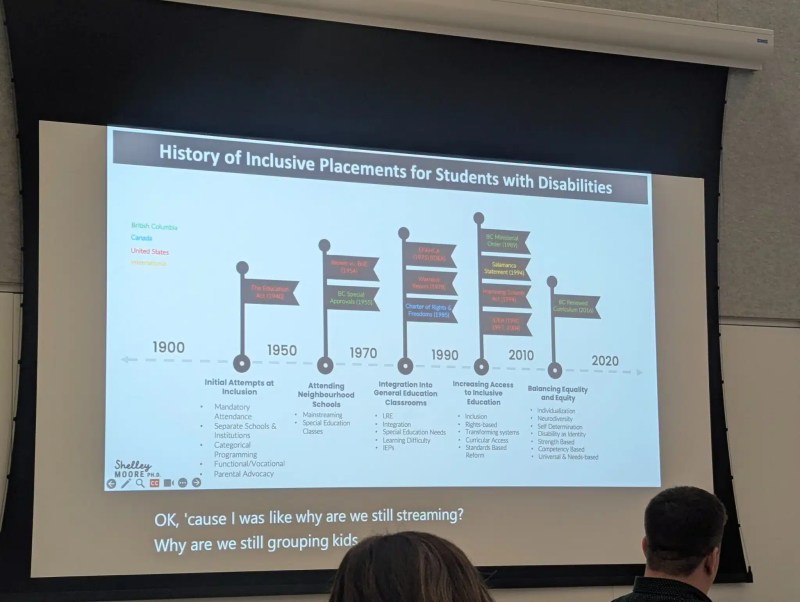
Photo of a slide from Dr. Shelley Moore’s conference
Imagine a children’s party where every child excitedly asks for a unicorn-shaped balloon—a symbol of perfection and conformity. In that setting, Shelley Moore’s daughter, confidently expressing her own identity, asks the balloon artist for something different… a bat.
This story illustrates perfectly the trap of assimilation. For decades, school systems have tried to turn “bats” into “unicorns” so they could blend into the crowd. Too often, students have been asked to hide who they are—their challenges, their autism, their differences—to earn the right to remain in the classroom.
Dr. Shelley Moore invites us to make a radical shift in perspective: the burden of inclusion should not rest on the marginalized student, but on the community itself.
In our schools, this means our mission is not to “normalize” the different learner, but to prepare the “unicorns” (the majority group holding privilege) to make real and meaningful space for the “bat.” After all, in a world of unicorns, the most powerful role is the unicorn who supports and celebrates the bat.
If a student must mask their identity, their autism, or their differences to succeed at school, we are not practicing inclusion, we are practicing assimilation.
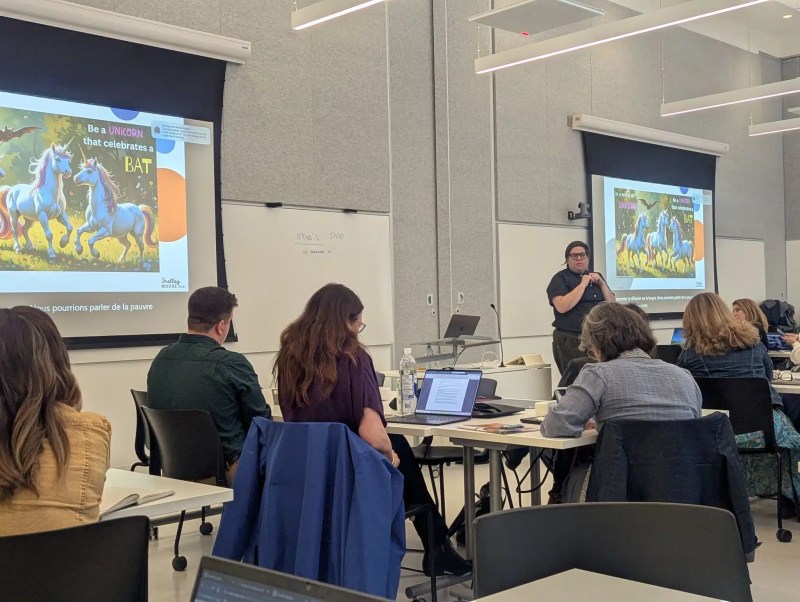
Photo of a slide from Dr. Shelley Moore’s conference
One of the key concepts presented by Dr. Shelley Moore is planning for diversity.
Too often, teachers view inclusion as extra work: “25 accommodations for 25 students.” Yet Dr. Moore argues that when we anticipate needs from the beginning—like the balloon artist who creates a dance area to help children manage waiting time—the work becomes simpler, more effective, and more sustainable.

Photo of a slide from Dr. Shelley Moore’s conference
Inclusion means moving from a classroom where we try to make every coloured dot “green” (compliant and standardized) to one where every colour becomes an opportunity for learning.
This is the principle of Universal Design for Learning (UDL): what is necessary for some becomes beneficial for all.
To make this vision actionable, Dr. Shelley Moore proposes five guiding conditions—the five “P’s”—that place responsibility on the system and the adults, rather than on the student:
Presume Competence
Adopt a growth mindset regarding every student’s potential.
Placement
The student must be physically present in the regular classroom.
Proximity
Students should actively participate with peers, rather than remain isolated with an educational assistant.
Purpose (Meaningful Roles)
Each student should have clear, valued responsibilities within the group.
Planning
Accessibility must be built into lesson design from the start—not added later.
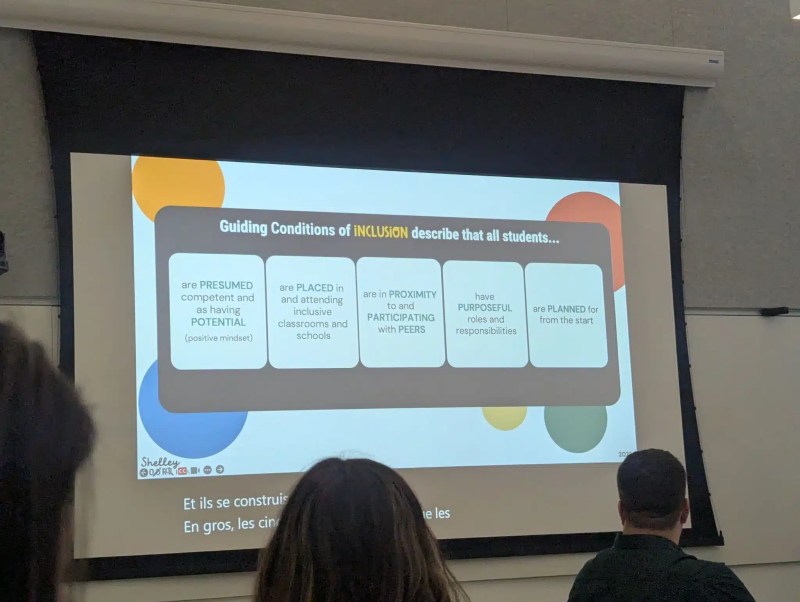
Photo of a slide from Dr. Shelley Moore’s conference
Dr. Shelley Moore compares education to a business model: if we are losing our “clients” because we are not meeting their needs, then it is the model that must change.
The urgency is not to change students, but to support adults in transforming their professional practices.
Inclusion is a journey with no final destination. It is a daily commitment to building a school community where every student, regardless of their “colour”, can say: “Here, I belong exactly as I am.”